
Software development is at a turning point.
For decades, building software has meant writing code line by line, navigating documentation, troubleshooting bugs, creating tests, and spending countless hours on repetitive tasks. AI is now transforming that entire workflow.
But this transformation isn't simply about writing code faster.
AI is changing how software is conceived, designed, built, tested, reviewed, and maintained. More importantly, it is redefining the role of the developer—from someone focused primarily on writing code to someone who defines intent, architects solutions, validates outcomes, solves complex problems, and collaborates with AI throughout the development process.
The future of software development isn't about AI replacing developers. It's about developers becoming more capable with AI.
AI Is Redefining the Development Workflow
One of AI's most transformative capabilities in programming is translating natural-language intent into functional code.
Developers describe what they need in plain language, and AI can produce an initial implementation—spanning functions, APIs, database queries, UI components, configuration files, boilerplate, and documentation.
The result?
Less time spent on mechanical implementation. More time spent on the problem itself.
This is driving a fundamental shift in the development cycle:
Traditional
Think → Code → Test → Debug
AI-Assisted
Think → Describe → Generate → Review → Test → Refine
The developer's role doesn't shrink—it elevates.
They remain the decision-maker, the quality gate, and the owner of the final solution.
AI as a Collaborative Coding Partner
AI delivers its greatest value not as an automatic code generator, but as an active collaborator across the entire development lifecycle.
A developer can engage AI to:
- Explain — “Walk me through this legacy function and map its dependencies.”
- Debug — “Analyze this error and surface the likely root causes.”
- Improve — “Refactor this code for readability and maintainability.”
- Test — “Generate unit tests covering both happy paths and edge cases.”
- Review — “Audit this implementation for security vulnerabilities and performance bottlenecks.”
This is what separates a coding partner from a code generator.
AI becomes useful at every stage of the process—not just when writing new code, but when understanding, fixing, hardening, and maintaining it.
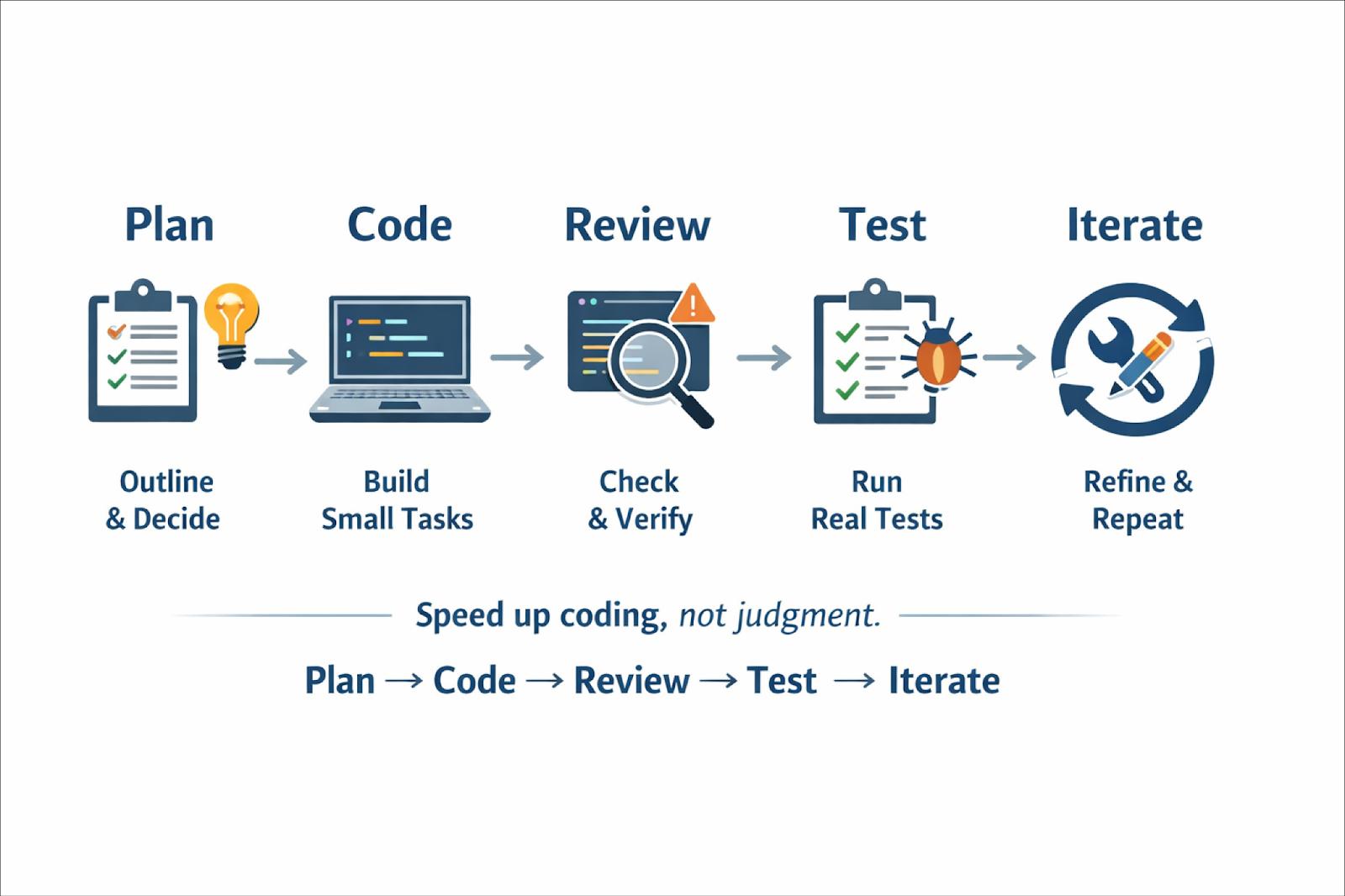
The Rise of AI-Assisted Development
Modern programming is becoming a collaborative discipline.
A typical AI-assisted workflow follows this rhythm:
1. Understand the Requirement
The developer defines the business problem and the expected outcome.
2. Explore Approaches with AI
AI suggests possible implementations and flags key considerations.
3. Generate the Initial Code
AI produces a working starting point.
4. Review and Refine
The developer examines, restructures, and aligns the code with the application's architecture.
5. Test
AI helps generate test cases and identify edge cases the developer might overlook.
6. Validate
The developer performs final technical and business validation.
Human Intent + AI Assistance + Human Judgment
That's the foundation of effective AI-assisted development.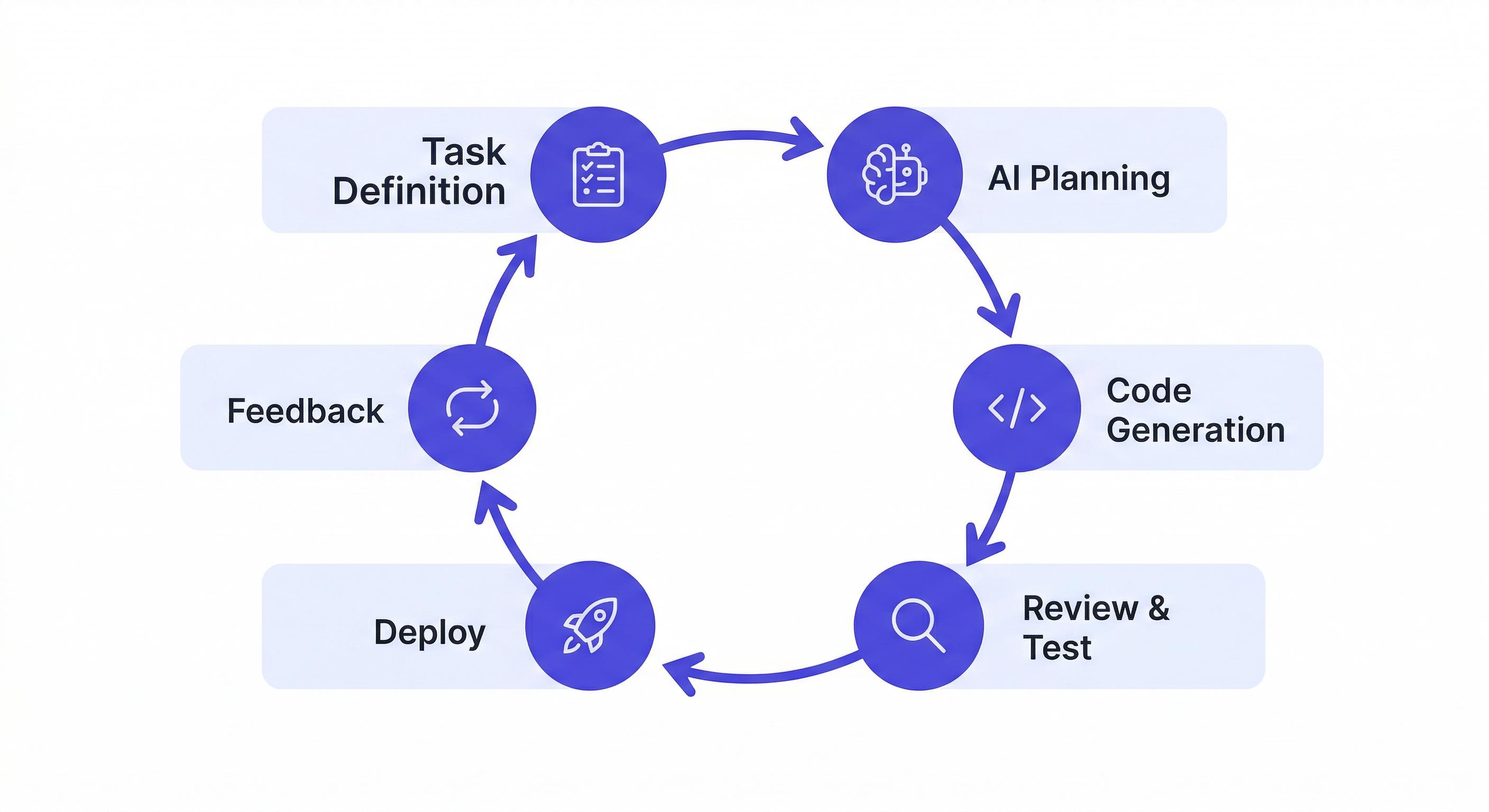
Benefits of AI in Modern Programming
When used responsibly, AI delivers significant advantages:
- Faster Development — Prototypes and initial implementations come together in a fraction of the time.
- Less Repetitive Work — Boilerplate and routine tasks are automated away.
- Faster Debugging — AI can analyze errors, parse logs, and navigate unfamiliar codebases.
- Stronger Testing — AI can surface edge cases and generate comprehensive test suites.
- Accelerated Learning — AI serves as an interactive guide when developers encounter unfamiliar technologies.
Better Documentation — AI helps create and maintain technical documentation, making systems easier to understand over time.
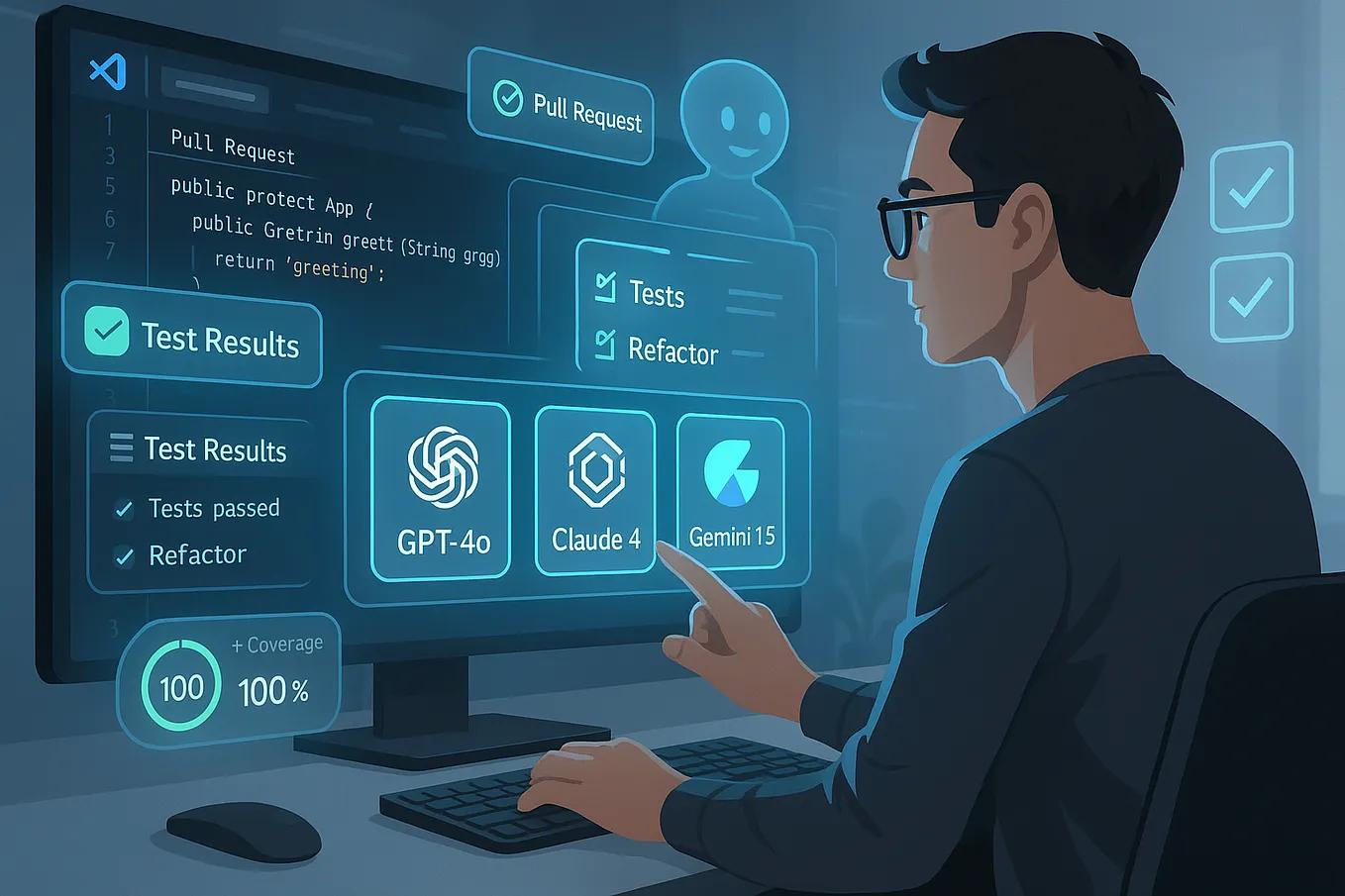
The goal isn't to write more code faster.
The goal is to deliver better software faster.
Challenges and Risks
AI-generated code is not automatically trustworthy.
It can contain:
- Logical errors and incorrect assumptions
- Security vulnerabilities
- Performance bottlenecks
- Outdated patterns
- Poor architectural decisions
There is also a real risk of over-reliance.
One rule should be non-negotiable:
Never deploy code you don't understand.
AI should support developer judgment—not replace it.
The Future of Programming
The future of programming will be less about manually writing every line and more about designing, directing, reviewing, and improving software.
AI handles the repetitive. Developers focus on the consequential.
The relationship is simple:
AI generates. Developers understand.
AI assists. Developers validate.
The strongest teams won't necessarily be the ones that use the most AI.
They'll be the ones that understand where AI adds value—and where human expertise is irreplaceable.
Conclusion
AI is reshaping modern programming—accelerating development, simplifying complex systems, strengthening testing, and eliminating busywork.
But the future isn't about AI replacing developers.
It's about developers becoming more capable with AI.
The programmer of tomorrow may write fewer lines of code by hand—but will need deeper skills in architecture, problem solving, security, system design, and critical thinking.
AI can write the code.
Great software still requires great engineering.